
 |
|---|
 |
 |
 |
 |
 |
 |
 |
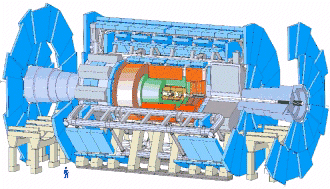
ATLAS (A Toroidal LHC Apparatus)
SCIPP is participating in physics studies using particle detectors located around the world and in space. The one shown above is named, ATLAS (A Toroidal LHC Apparatus). These detectors are used to discover and study the smallest components of matter, termed "elementary particles," and to learn about the forces that cause them to interact and combine.
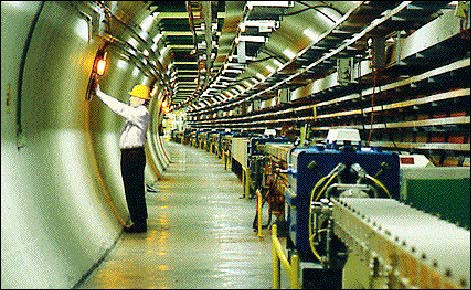
This is the underground tunnel of the Large Hardon Collider (LHC) accelerator ring, where the proton beams are steered in a circle by magnets. The LHC is the accelerator facility (in France and Switzerland) that contains the ATLAS detector.